The Hard Truth About Fluency: You Just Need More Words
Grammar won't save you if you have no vocabulary. Here's why massive reading and listening is the only reliable path to fluency — and how to make it work.
The Hard Truth About Fluency: You Just Need More Words
You can master every grammar rule in Spanish and still freeze the moment a native speaker opens their mouth. You can ace the conjugation tables and produce sentences that are technically correct but feel hollow, mechanical — translated from English rather than truly spoken.
The missing ingredient is almost always the same thing: vocabulary.
Not grammar. Not pronunciation drills. Not conversation practice (not yet, anyway). Words. Thousands and thousands of words, encountered so many times in so many contexts that they stop feeling like foreign objects and start feeling like your own.
Why vocabulary is the real bottleneck
Think about what actually happens when you try to speak. You have a thought. You reach for words. Either the words are there — instantly, automatically — or they’re not. If they’re not, the conversation stalls while you mentally search, conjugate, second-guess. The other person waits. You apologize. The moment passes.
Grammar can smooth things out, but it can’t create something from nothing. You cannot construct a sentence about something you have no words for. Vocabulary is the raw material everything else is built from.
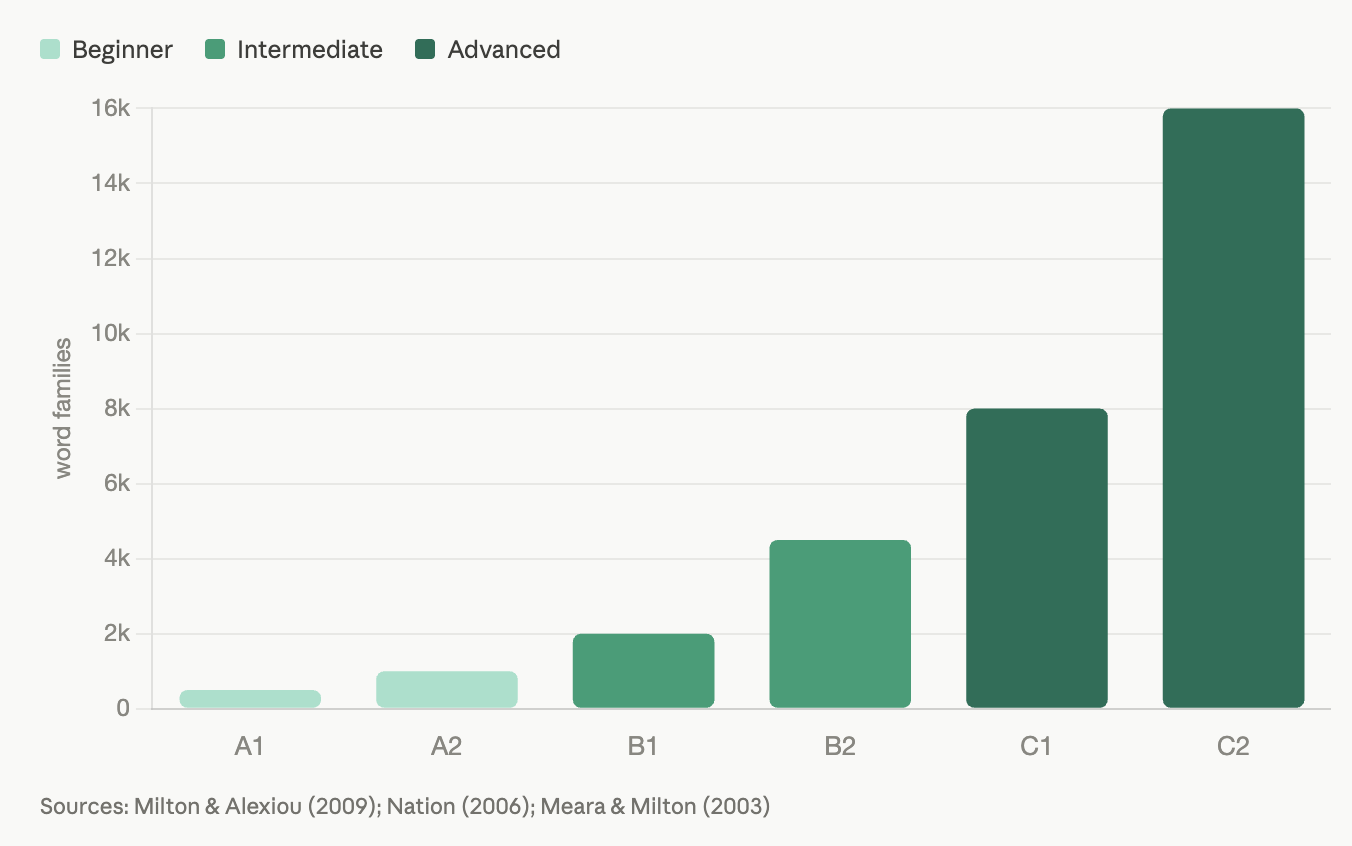
Researchers generally agree that you need around 8,000 word families to read a newspaper comfortably in a second language, and somewhere between 3,000 and 5,000 to handle most everyday conversations. That’s not a small number. No flashcard deck gets you there. No course gets you there. Only one thing reliably produces vocabulary at that scale: massive amounts of reading and listening.
Why reading and listening work when nothing else does
When you encounter a word in real content — a novel, a podcast, an article — your brain doesn’t just log a definition. It logs an entire scene:
- The sentence the word appeared in
- The emotional tone of that moment
- The words that surrounded it
- The context that made its meaning obvious (or almost obvious)
Each of those details is a retrieval hook. The more hooks, the more durable the memory. The more times you encounter a word across different contexts, the more automatic retrieval becomes — until one day you’re not “remembering” the word at all. You’re just using it.
Flashcards give you one hook per word. Real content gives you dozens. And unlike flashcards, real content is actually enjoyable — which means you’ll do more of it, which means you’ll acquire more vocabulary, which means fluency compounds faster than any structured study program can match.
The progress problem
The challenge with vocabulary-building through immersion is that it can feel invisible. You’re reading, you’re listening, but how much are you actually retaining? How do you know if you’re making progress?
This is where most learners either give up or retreat to structured study — not because immersion isn’t working, but because they can’t see it working.
Lingua Verbum is built specifically to solve this. Every word you encounter gets tracked. Every word you look up gets logged. Over time, the app builds a model of your vocabulary — what you know, what you’ve seen before but haven’t locked in, what’s completely new.
That model gets surfaced in the most useful way possible: color-coded directly on the text you’re reading.
Words you know well appear normally. Words you’ve seen but haven’t solidified show up in one color. New words appear in another. At a glance, you can see exactly where you are, what’s likely to trip you up in the next paragraph, and how your vocabulary is growing over time.
It turns the invisible process of acquisition into something you can actually watch happen.
The dictionary that doesn’t interrupt you
The other thing that kills immersion is friction. You hit an unknown word. You open a browser tab. You type it in. You get a list of definitions with no context. You try to figure out which one applies. You’ve lost the thread of what you were reading.
In Lingua Verbum, you tap the word. You get the definition — not a list of possibilities, but the meaning in the context of that specific sentence, generated from what’s actually happening in the passage. Then you keep reading.
That’s it. The dictionary is embedded in the experience rather than pulling you out of it. You stay in the flow state where real acquisition happens.
What this looks like in practice
Pick something you’d genuinely want to read or listen to in English — a thriller, a cooking show, a sports podcast. Find a version in your target language. Start consuming it in Lingua Verbum.
You won’t understand everything. That’s fine — you’re not supposed to. You’re looking for the gist, not perfection. Over thousands of pages and hundreds of hours, the words you encounter repeatedly will stop being foreign and start being yours.
No one gets to fluency without putting in this volume. The good news is that with the right tools, it stops feeling like study and starts feeling like entertainment.
The words will come. You just have to give them somewhere to come from.